← All research|Also available in 中文
Liveness Screen — Fixing the Dead-Token Weight Flaw in the KKT Macro Loop
Published: 2026-08-07
Simulated results — no real money. Every figure below is computed from historical price data by a backtest. No capital was invested and no orders were placed. Backtests apply a strategy to the past with full knowledge of how that period turned out, and the figures exclude slippage and liquidity effects, though a simulated 0.1% exchange fee is charged on every rebalance, DCA buy and redeployment. Simulated and past performance is not a reliable indicator of future results. AQMath is software, not investment advice.
Date: 2026-08-07
Engine: Dual-Speed E2E — identical wiring to the live paper trading service (180-day KKT risk-parity MACRO loop + Aegis (v14) Deleverage Shield)
Status: 📊 RESEARCH — component design study, implemented in the production service
1. Objective
The KKT risk-parity MACRO loop allocates purely on volatility and covariance. That is a strength — no narratives, no timers — and a blind spot: a token whose market has effectively died keeps printing daily closes, and its collapsed, low-amplitude price path looks low-risk. The optimizer can hand a dead token a real share of the frozen sleeve.
This study (a) reproduces that failure mode exactly, (b) tests candidate liveness screens, (c) selects one and verifies it on the production code path, and (d) runs it in the live paper trading service.
One rule frames the whole design: a frozen sleeve is never modified after it freezes. The screen operates exclusively at re-optimisation boundaries — it inspects trailing data and shapes the sleeve that is about to be frozen for the next window. Any sleeve that is already live runs to the end of its window exactly as frozen.
2. The failure mode, reproduced
Test basket C LANDMINE: BTC, ETH, CEL (Celsius — bankrupt since mid-2022, exchange frozen, token kept trading on thin secondary markets) + PAXG gold anchor. Walk-forward, 180-day re-optimisation, production math, no parameter changes. Window 2020-03 → 2026-08, $1,000 start, DCA $100/30d, 10 bps fee.
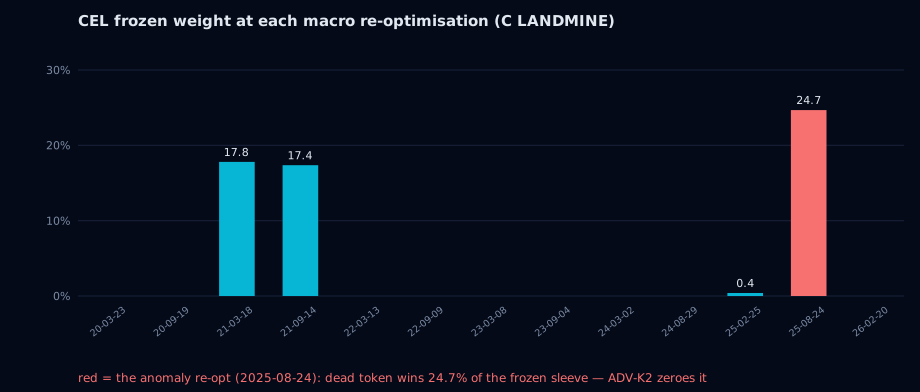
At the 2025-08-24 re-optimisation the optimizer produced this frozen sleeve:
| Token | 30-day vol | Frozen weight |
|---|---|---|
| BTC | 1.72% | 31.3% |
| ETH | 4.43% (highest in basket) | 0.0% |
| CEL | 2.30% | 24.7% |
| PAXG | 0.62% | 44.0% |
The mechanism: the macro optimiser pairs every token with a dynamic weight ceiling that tightens as its recent volatility rises — the most volatile member of the basket is always squeezed out entirely — and the resulting weights are renormalised to 100%. ETH was the most volatile token that day, so it took zero — and the dead CEL token, whose price barely moved, inherited a 24.7% frozen weight purely because a collapsed chart has low measured volatility. Nothing in the volatility math can see that the market behind those closes is gone.
3. Candidate screens — what we tested and rejected
All screens use trailing data only (≤ the re-optimisation date) and were walked through every one of the 13 re-optimisations of basket C.
| Variant | Rule | Result | Verdict |
|---|---|---|---|
| Universe exclusion | drop failing token before optimizing | final $14,336, Calmar 0.50, BTC squeezed to cap 0 at two later re-opts | ❌ removing a token flips the max-vol cap dynamics |
| Collapse return | trailing-180d return < −80% | never fired — CEL's trailing return at the anomaly date was only −48.5% | ❌ misses the actual failure |
| Relative volume | ADV < 1% of basket median ADV | final $10,696, Calmar 0.13 — also zeroes PAXG (gold is structurally low-volume) | ❌ punishes the defensive anchor |
| ADV-K2 cap-zero | trailing-180d avg dollar volume < $1M at two consecutive re-opts → weight zeroed, survivors renormalized | anomaly removed, metrics improve (below) | ✅ selected |
The winning design is a cap-zero screen: the KKT optimizer always runs on the full basket universe (caps and covariance untouched); the screen then filters the optimizer's output before the sleeve freezes for the coming window — screened tokens enter the new sleeve at zero weight and the survivors are renormalized. Nothing that is already frozen mid-window is ever touched. The persistence requirement (two consecutive re-optimisations, ~one year) guarantees one bad data day can never zero a live token.
4. Results — basket C LANDMINE
| Metric | No screen (baseline) | ADV-K2 liveness screen | Buy & Hold |
|---|---|---|---|
| Final value | $16,163 | $17,541 (+8.5%) | $21,732 |
| CAGR | 10.2% | 11.6% | 15.5% |
| Max drawdown | 14.1% | 17.8% | 31.2% |
| Sharpe | 0.24 | 0.32 | 0.32 |
| Calmar | 0.72 | 0.65 | 0.50 |
The screen fired exactly once in six years — at the anomaly re-opt (2025-08-24), zeroing CEL's 24.7% and renormalizing the sleeve to BTC 41.6% / PAXG 58.4%.
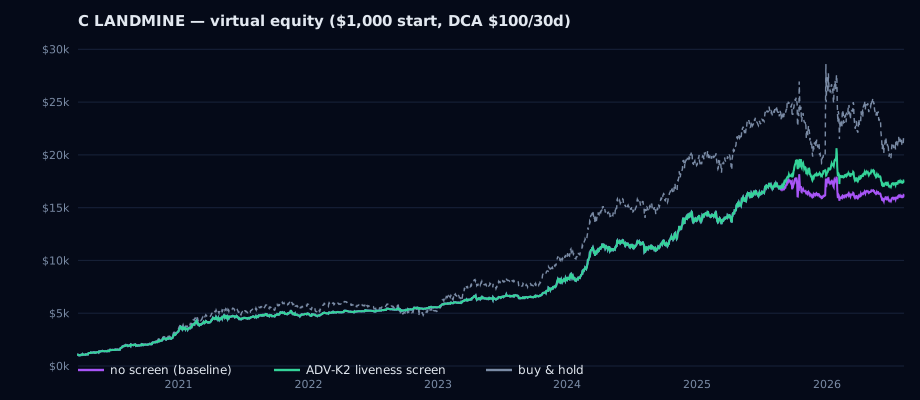
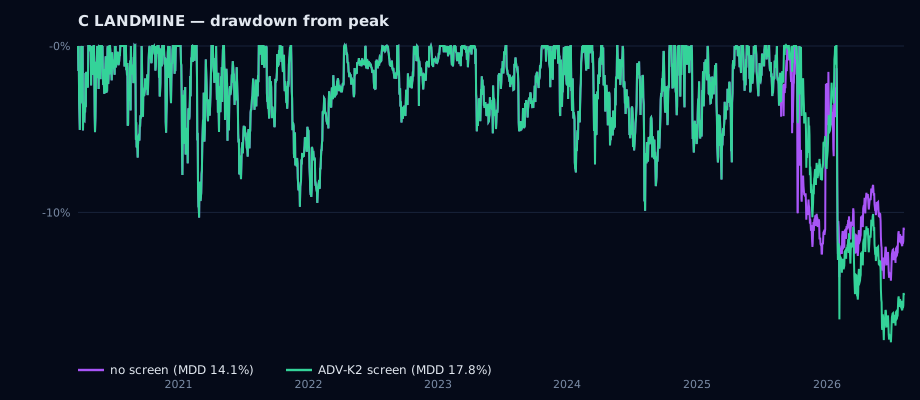
Honest trade-off: the screened sleeve is BTC-heavier, so the 2025-26 correction cut deeper — max drawdown rises 14.1% → 17.8% and Calmar drops 0.72 → 0.65 (still above Buy & Hold's 0.50). In exchange the strategy gains +8.5% final value and a meaningfully higher Sharpe, and the systemic flaw is gone.
Zero collateral cost: the same screen was walked over two all-live control baskets (majors + gold, and the 2019-20 generation basket): it never fired there and the results are bit-identical to the unscreened baseline.
5. Why the backtest understates the real benefit
A daily-close backtest prices volatility, not exit risk. The 24.7% CEL position is marked at closes that assume you can sell at that price; in a dead market the real cost is slippage, thin books, or no exit at all. That loss never appears in backtest metrics — which is exactly why the naive "just optimize harder" intuition fails here. The screen is justified operationally; the backtest shows only that it does no net harm.
6. Production implementation
The screen is implemented in the live paper trading service (liveness.py, wired into both forward logs at their macro re-optimisation points). Timing: it runs inside each re-optimisation step, before the new sleeve freezes — the active sleeve of the current window is never modified. The implementation:
- Volume feed: the CoinGecko
total_volumesseries (USD-denominated) from the raw collector table. The cleaned price table's volume column is not used — it mixes USD and base-unit volumes from different exchanges. - Rule: trailing-180d average dollar volume < $1M ⇒ fail; a token is zeroed only after failing at two consecutive re-optimisations (K=2), with the fail state persisted in the database across redeploys.
- Fail-open everywhere: a symbol with fewer than 90 volume-days of coverage in the window is never screened; a database error leaves the frozen weights untouched. The screen can only ever reduce exposure to dead tokens — it can never break the loop.
- Cap-zero mechanics: the optimiser runs on the full universe exactly as before; only the optimiser's output is adjusted before freezing (zero + renormalize), and every zeroing is logged and attached to the frozen-weights warnings.
Verified against the production modules: 19/19 checks pass, including an exact reproduction of the 24.7% anomaly by the macro_reoptimize path and its correction to BTC 41.6% / PAXG 58.4% in the sleeve the screen lets freeze.
7. Caveats
- The study window uses research-grade (Yahoo) volume for the screen walk; the production service reads exchange-aggregated CoinGecko volumes. The threshold is deliberately coarse ($1M/day) so the two feeds agree on which side of it a dead token sits.
- $1M/day is a judgment call: high enough to mark a market as un-exitable for our sizes, low enough never to touch any token that currently trades in the live baskets.
- The screen fires at re-optimisation boundaries (every ~180 days) — it is a composition guard, not an intraday circuit breaker. The Deleverage Shield remains the fast layer.
- Historical study with simulated fees and closes; nothing here is financial advice.
8. Verdict
The volatility-only optimizer has a real, reproducible blind spot for dead tokens — and it now has a surgical fix. The ADV-K2 cap-zero screen removed the 24.7% dead-token allocation in the stress basket, improved final value by 8.5% and Sharpe from 0.24 to 0.32, cost a contained 3.7 pp of max drawdown, was bit-identical (zero cost) on both live-token control baskets, and is running in the production forward logs.
All figures are simulated on historical daily closes with 10 bps fees, $1,000 start and $100/30d DCA. Past performance does not guarantee future results. This is research content, not financial advice.