← All research|Also available in 中文
Graveyard Gauntlet — who saves the basket when tokens die?
Published: 2026-08-07
Simulated results — no real money. Every figure below is computed from historical price data by a backtest. No capital was invested and no orders were placed. Backtests apply a strategy to the past with full knowledge of how that period turned out, and the figures exclude slippage and liquidity effects, though a simulated 0.1% exchange fee is charged on every rebalance, DCA buy and redeployment. Simulated and past performance is not a reliable indicator of future results. AQMath is software, not investment advice.
Date: 2026-08-07
Engine: Aegis (v14) Dual-Speed E2E — identical wiring to the live paper trading service (180-day KKT risk-parity MACRO loop with the ADV-K2 liveness screen + Aegis (v14) Deleverage Shield)
Status: 📊 RESEARCH — worst-case stress basket, no basket promoted
1. Objective
Every earlier study asked how the Shield behaves in crashes. This one asks a nastier question: what happens when the basket itself contains tokens that die — exchange tokens and lending tokens that went to zero in 2022?
Basket G is built as a worst case: BTC, ETH, PAXG plus three corpses — CEL (Celsius, bankrupt July 2022), LUNC (Terra Classic, May 2022 collapse), FTT (FTX, November 2022 collapse). The window runs 2020-03 → 2026-08, long enough to hold each token before its death, through it, and for years after.
The system has three layers that could plausibly protect it:
1. The optimizer — the KKT risk-parity re-optimisation can refuse to allocate to a deteriorating token before it dies. 2. The Shield — the drawdown modulator can de-risk the whole basket during the death. 3. The liveness screen — the ADV-K2 cap-zero screen can zero tokens whose trailing dollar volume has died.
The study runs the basket twice — with the production screen and with the screen switched off — and attributes the protection honestly. The honest answer surprised us, and we publish it as measured.
2. The system survives the graveyard
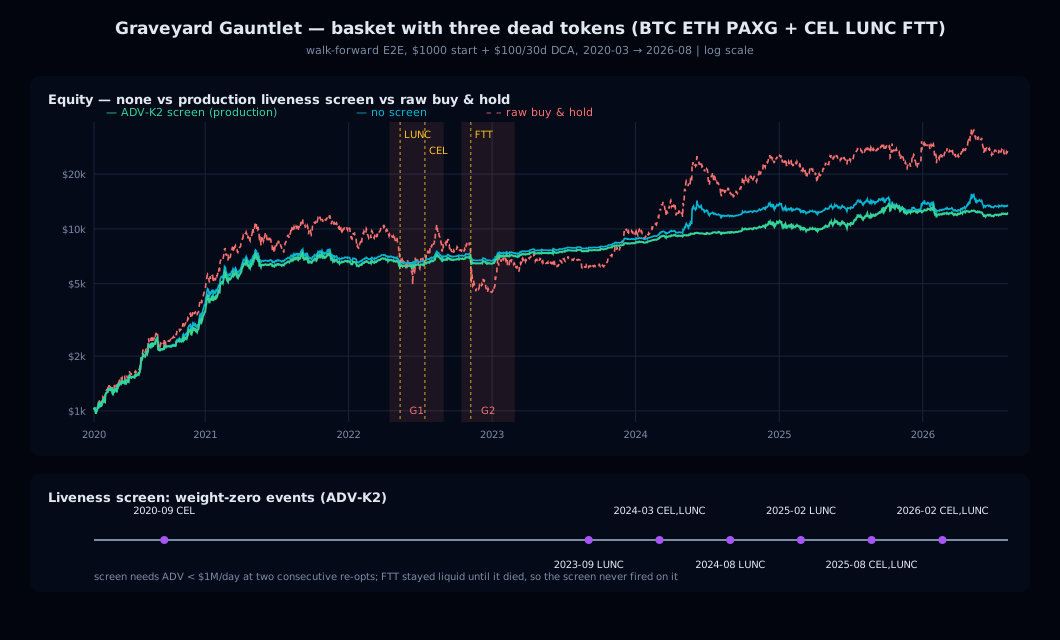
Buy & hold on basket G is a disaster by construction: three of six tokens go to (near) zero, and the raw basket draws down 62% across the window. The strategy's experience of the same basket is a different animal.
| Death event | Strategy equity at death | 30 days later | Change |
|---|---|---|---|
| LUNC collapses (2022-05-12) | $6,542 | $6,483 | −0.9% |
| Celsius bankrupt (2022-07-14) | $6,684 | $7,522 | +12.5% |
| FTX collapses (2022-11-08) | $6,925 | $6,833 | −1.3% |
No single death costs the strategy more than ~1.5% of equity; the CEL date is even positive because the Shield had already de-risked and the survivors caught the bounce. Over the two named death regimes the cut versus buy & hold is ~36-38 percentage points of drawdown:
| Regime | Strategy MDD | Buy & Hold MDD | Cut |
|---|---|---|---|
| G1 LUNA+CEL deaths (2022-04 → 2022-08) | 13.3% | 48.9% | +35.6 pp |
| G2 FTT death (2022-10 → 2023-02) | 11.1% | 48.7% | +37.6 pp |
3. Who did the work — the honest attribution
Here is the part a marketing page would skip: the liveness screen did not save the basket during the deaths. With the screen off, the death-regime drawdowns are 13.4% and 11.2% — statistically the same as the screened run's 13.3% and 11.1%. The attribution decomposes cleanly:
Before the deaths: the optimizer. The risk-parity re-optimisation had already excluded LUNC from the frozen weights from late 2020 — a token with thin volume and pathological volatility simply does not win weight in the KKT solution. LUNC's May-2022 collapse therefore hit an (almost) empty position in both runs.
During the deaths: the Shield. The risky exposure path shows the modulator doing its job in real time: entering the LUNA contagion at 0.28 exposure, it was down to 0.11 within a week of the crash; entering the FTX collapse at 0.27, it was at 0.05 five days later. That de-risking is identical in both runs, which is exactly why the screen on/off comparison is flat during the deaths.
After the deaths: the screen. The ADV-K2 screen's real job turns out to be hygiene, not rescue: from 2023 onward it fires seven zeroing events that stop zombie tokens from re-entering the frozen weights (the optimizer will happily re-allocate to a cheap, low-correlation corpse). It also fired early once — zeroing CEL in September 2020 on dead volume, 21 months before the bankruptcy.
The FTT lesson. FTT was liquid right up to the day FTX died — its dollar volume was far above the screen's threshold, so no liquidity screen can ever catch a solvency collapse. Both runs carried FTT into the FTX collapse, and the Shield absorbed it (11.1% regime MDD against 48.7%). This is a structural limit of volume-based screening, and we state it plainly: the screen guards against tokens that die slowly, not against counterparties that die overnight.
4. The price of insurance
Honesty requires the other side of the ledger. On this single realized path, the screened run finishes below the unscreened one ($12,155 vs $13,402, full-window MDD 17.9% vs 18.3%): the early CEL zeroing skips part of CEL's 2021 rally, and the post-2023 zombie cleanup skips LUNC's 2026 rally. The screen is insurance, and on this one path the premium was not repaid in return — it was paid in avoided risk that the equity curve cannot show.
We do not read this as an argument against the screen. One realized path is not a distribution: for every LUNC-2026 rally there are many paths where the zombie keeps dying and the re-entry loses money. But a study that reports only the rescue and not the premium would be selling, not measuring. The screen's measured role is narrow and real: it keeps dead tokens out of the optimizer's future, and it cannot — and does not claim to — predict which living token dies next.
5. Caveats
- One realized path. The graveyard is a single historical sample. The attribution (optimizer / Shield / screen) is robust within it, but the size of the insurance premium is path-dependent.
- Yahoo price data for LUNC/FTT. LUNC carries the pre-redenomination price level, so the May-2022 burn appears as a ~total crash — which is also what holders actually lost. FTT trades at cents on Yahoo after the collapse; both are the right stress inputs, but they are not exchange-grade series.
- Thin CEL volume. CEL's dollar volume comes from a small exchange universe; the screen's 2020 CEL zeroing is directionally correct but the exact ADV level is approximate.
- Not a production basket. Basket G is a stress construct; no promoted basket holds dead tokens. The study stresses the mechanisms, not a product allocation.
- Weights are internal. Per-token frozen weights are deliberately not published; the charts show equity, exposure and event dates only.
6. Verdict
Put three dead tokens in the basket and the system still refuses to die: ~18% full-window max drawdown against 62% for buy & hold, and no single death costs more than ~1.5% of equity. The protection is real — but the attribution is not what a naive pitch would claim. The optimizer dodges the slow deaths before they happen, the Shield absorbs the fast ones within days, and the liveness screen cleans up the corpses afterwards. Each layer does a different job; none of them pretends to predict an overnight solvency collapse. That division of labour, measured and published with its premiums, is the actual robustness story.
Simulated on historical daily closes with fees; nothing here is financial advice.