← All research|Also available in 中文
Static vs. Dynamic: The Test the Shield Only Half-Passed
Published: 2026-08-12
Simulated results — no real money. Every figure below is computed from historical price data by a backtest. No capital was invested and no orders were placed. Backtests apply a strategy to the past with full knowledge of how that period turned out, and the figures exclude slippage and liquidity effects, though a simulated 0.1% exchange fee is charged on every rebalance, DCA buy and redeployment. Simulated and past performance is not a reliable indicator of future results. AQMath is software, not investment advice.
Date: 2026-08-12 Engine: Aegis (v14) Deleverage Shield — the same code that runs in production, unchanged Status: Gates 2/4 — Shield wins protection (MaxDD, Calmar) but loses the return gates: a robot-rebalanced 60/40 beats it on Sharpe and doubles its final equity · 30 seeds per behavioral scenario
Read this in 60 seconds
- The simplest value test there is: does the Shield beat a static crypto/ stablecoin split you could draw on a napkin?
- Outside-the-box twist: the competitor was tested at three levels of human-ness — a robot (rebalanced yearly), a drawer (never touched), and a human (capitulates when the pain gets too big).
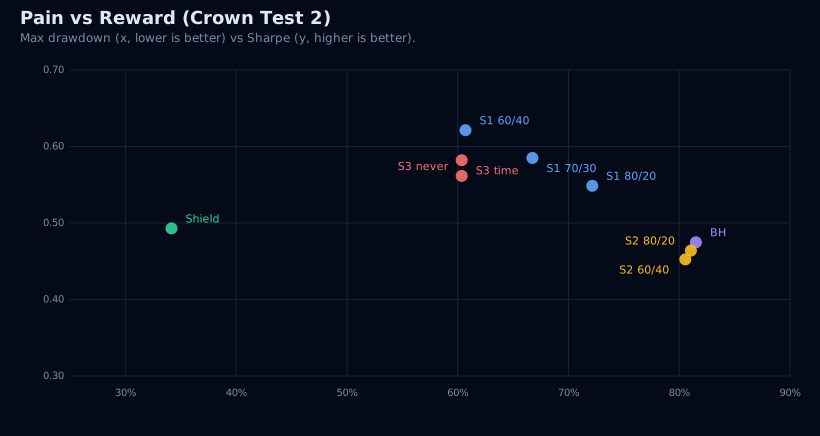
- Protection gates pass: Shield MaxDD 34.2% vs 60.7–81.1% for every static variant; Calmar is the best of all nine strategies.
- Return gates fail: the robot 60/40 has a higher Sharpe (0.621 vs 0.493) and ends with more than double the equity.
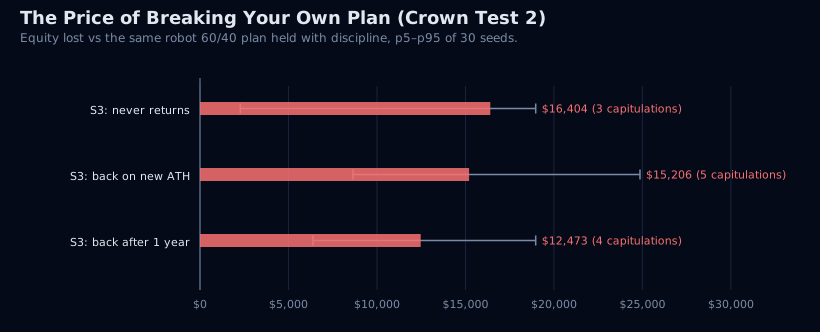
- But the robot does not exist. The human versions of the same plan broke it 3–5 times each, gave up $12.5k–$16.4k per simulated lifetime, and spent ~81% of the window in stablecoin anyway.
Vocabulary used below: MaxDD (maximum drawdown) — how far the portfolio falls from its highest point. Sharpe — return earned per unit of risk; higher is better. Calmar — annualized return divided by MaxDD; reward per unit of pain sat through.
1. Objective
If the Shield does not beat a simple strategy — hold X% in crypto, (100−X)% in stablecoin — then all of its complexity is unnecessary. That is the cleanest possible test of added value, and it was the second crown test on the plan.
One lesson from the Human Factor series shaped the design: a robot competitor is not a real competitor. The previous tests modeled human error as mechanical randomness; the human themselves — fear, panic, giving up — never entered the test. A static 60/40 that never flinches through a 60% drawdown is the strongest possible version of the alternative. Beating only that version proves little; beating it and the human version is actual evidence.
One asymmetry is stated up front, not hidden: static allocations have zero operational surface — no signals to miss, nothing to execute late. The Human Factor series measured exactly that price on the Shield side. This comparison is therefore protection per unit of discipline required, and the article says so out loud.
2. Design
Everything shares the same inputs: basket ADA, BNB, ETH, XRP, SOL (equal-weight risky sleeve), 2020-04-10 to 2026-07-04 (6.2 years, two bear cycles), $1,000 start, $100 every 30 days perfect DCA, 0.1% fee per trade, stablecoin earns zero. The DCA dimension stays perfect — jitter was already tested in the Human Factor series.
| Strategy | Risky | Stable | Behavior |
|---|---|---|---|
| BH | 100% | 0% | Buy & Hold reference |
| S1 — Textbook (robot) | 60/70/80% | rest | rebalanced to target once per year |
| S2 — Drawer (drift) | 60/70/80% | rest | never rebalanced — the sleeve drifts |
| S3 — Capitulation (human) | 60% plan | rest | holds the S1 plan until own equity drawdown crosses ~35%, then all-stable; three re-entry rules |
| Aegis (v14) Shield | dynamic | dynamic | production config, same-day execution |
S3 details: the pain threshold is 35% ± 5 percentage points, jittered per seed (30 seeds). Re-entry variants: never return, return only on a new all-time high of the basket (buying the top), or return after one year out. After re-entry the plan resumes, and the human can break it again.
S2 deserves a sentence: in a bull run the risky side grows, so a "set and forget" 60/40 silently becomes ~90/10 exactly at the top — full exposure into the crash. That drift is not a strawman; it is the most common real-world version of a static split.
3. Results — robot and drawer
| Strategy | MaxDD | Sharpe | Calmar | CAGR | Final |
|---|---|---|---|---|---|
| BH | 81.5% | 0.475 | 0.510 | 41.6% | $74,199 |
| S1 60/40 robot | 60.7% | 0.621 | 0.643 | 39.1% | $66,241 |
| S1 70/30 robot | 66.7% | 0.585 | 0.600 | 40.0% | $69,163 |
| S1 80/20 robot | 72.2% | 0.549 | 0.565 | 40.8% | $71,501 |
| S2 60/40 drawer | 80.5% | 0.452 | 0.482 | 38.8% | $65,595 |
| S2 70/30 drawer | 80.8% | 0.458 | 0.489 | 39.6% | $67,746 |
| S2 80/20 drawer | 81.1% | 0.464 | 0.497 | 40.3% | $69,897 |
| Aegis (v14) Shield | 34.2% | 0.493 | 0.659 | 22.5% | $30,121 |
Three facts stand out:
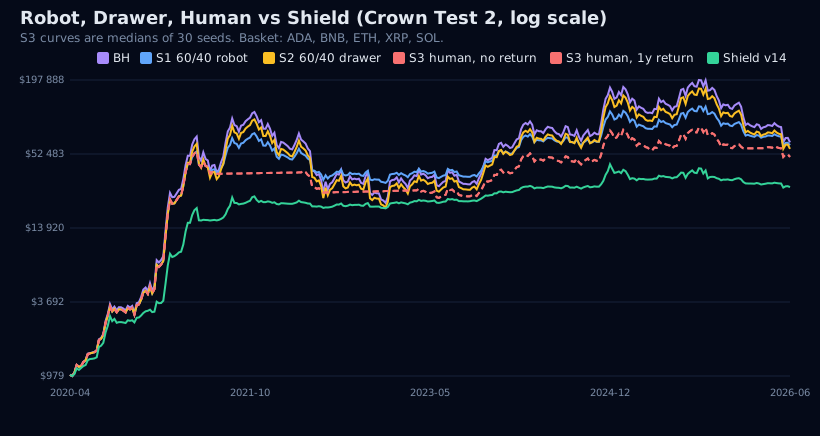
1. The robot is strong. The textbook 60/40 with one rebalance a year has the highest Sharpe of everything tested here, Shield included. Six rebalances in 6.2 years, $48 of fees. 2. Drift eats protection, not return. The drawer variants end with barely less money than the robot (−$646 at 60/40) but carry almost the full Buy & Hold drawdown (80.5% vs 60.7%). The yearly rebalance bought pain reduction, not return. 3. The Shield is the only strategy under 35% MaxDD — and it pays for it. Defensive 1,758 of 2,275 days (77%), final equity less than half of the robot 60/40.
4. Results — the human
The S3 operator holds the robot's exact plan until their own equity drawdown crosses ~35% (median realized threshold 34.0–34.2%), then sells everything into stablecoin. Medians of 30 seeds:
| Re-entry rule | MaxDD | Sharpe | Final | Damage vs own plan | Capitulations | Days out |
|---|---|---|---|---|---|---|
| Never returns | 60.4% | 0.562 | $53,768 | $16,404 ($2.3k–$19.0k) | 3 | 1,837 |
| Back on new ATH | 65.7% | 0.564 | $52,376 | $15,206 ($8.6k–$24.9k) | 5 | 1,682 |
| Back after 1 year | 60.4% | 0.582 | $53,768 | $12,473 ($6.4k–$19.0k) | 4 | 1,838 |
Read that slowly:
- Every human broke the plan. 30 seeds, three re-entry rules — not one simulated person held the 60/40 through the pain. Median 3–5 capitulations per lifetime.
- They were out of the market ~81% of the window (1,682–1,838 of 2,275 days) — and still lived through a 60–66% drawdown before breaking.
- Breaking the plan cost $12.5k–$16.4k against the same plan held robotically. The "buy the new ATH" re-entry is the worst on MaxDD (65.7%) because it systematically re-enters at tops.
5. The gate scorecard
The pass criteria from the original test plan, verbatim:
| Gate | Requirement | Result | Verdict |
|---|---|---|---|
| MaxDD | Shield < all statics | 34.2% vs 60.7–81.1% | ✅ PASS |
| Calmar | Shield > best static | 0.659 vs 0.643 | ✅ PASS |
| Sharpe | Shield ≥ best static | 0.493 vs 0.621 | ❌ FAIL |
| Final equity | within 80–120% of best static | 45% of best | ❌ FAIL |
2 of 4. The Shield dominates on every metric that measures pain and loses on every metric that measures terminal wealth in this window.
6. Honest reading
1. The protection is real and it is the best in class. MaxDD 34.2% against 60.7–81.1% for every static variant, and the highest Calmar of all nine strategies — the best return per unit of pain actually sat through. That is the product's promise, and this test confirms it.
2. The return cost is real and now quantified. In a 6.2-year window containing two enormous bull markets, constant exposure was rewarded. The Shield sat defensive 77% of days, trailed Buy & Hold on 2,268 of 2,275 days, and ended ~$36k behind the robot 60/40. Anyone who could hold a 61% drawdown without flinching should, by this data, prefer the robot. The test says so plainly.
3. The robot does not exist. Zero of 30 simulated humans held the plan. They capitulated 3–5 times, gave up $12.5k–$16.4k of equity each, spent ~81% of the window in stablecoin — and still suffered a 60–66% drawdown. The honest comparison is therefore not "Shield vs robot 60/40" but "Shield vs what a person actually does with a 60/40": $30,121 at 34% MaxDD vs ~$52–54k at 60–66% MaxDD plus three broken promises to oneself.
4. What this means. The Shield is not a return-maximizer and this test refuses to pretend otherwise. It is a pain manager — and the premium paid for the pain management in this window was about $36k on a $30k outcome. Whether that trade is worth it is a personal risk-tolerance question; the data now prices it exactly.
7. Test details
- Basket: ADA, BNB, ETH, XRP, SOL (equal weight)
- Window: 2020-04-10 to 2026-07-04 (2,275 days, 6.2 years)
- Start capital: $1,000 · DCA: $100 every 30 days (perfect)
- Fee: 0.1% per trade · Stablecoin yield: 0
- S1 rebalance: every 365 days to target; dust under $1 ignored
- S3: base plan = S1 60/40; capitulation threshold 35% ± 5 pp (per seed); re-entry: never / new basket ATH / 365 days; plan resumes after re-entry, repeatable
- Shield: production
default_config, same-day execution (the operating requirement documented in the Human Factor series) - Seeds: 30 per S3 variant; deterministic strategies run once
8. Reproducibility
All strategies run on the same 6.2 years of daily closes with the unmodified production engine for the Shield leg. Test scripts, chart generators, and raw result data live in the engine's internal research tooling; every reported median is across 30 seeds.
This is the second of five planned crown tests for the Aegis (v14) Deleverage Shield. Test 1 (Human Factor) is published here. Verdict here: 2/4 gates — the Shield dominates protection and pain-adjusted return, loses the return gates to a robot that does not exist, and beats the human version of its own competitor on every axis except terminal wealth. Next: Test 3, liquidity execution.