← All research|Also available in 中文
Locked Out? What Happens After the Shield Goes Defensive
Published: 2026-08-18
Simulated results — no real money. Every figure below is computed from historical price data by a backtest. No capital was invested and no orders were placed. Backtests apply a strategy to the past with full knowledge of how that period turned out, and the figures exclude slippage and liquidity effects, though a simulated 0.1% exchange fee is charged on every rebalance, DCA buy and redeployment. Simulated and past performance is not a reliable indicator of future results. AQMath is software, not investment advice.
Date: 2026-08-18 Engine: Aegis (v14) Deleverage Shield on the production KKT stack — ERC risk-parity weights (180d lookback, 180d re-opt, 60/40 risky/USDC), same code that runs in production, unchanged Status: Gates 1/4 — Shield re-enters fast (median 1 day to 50% exposure) but captures only 32% of the Buy & Hold recovery at 12 months · 11 defensive episodes across 6.2 years · zero cycles where Shield equity exceeds B&H after 12m
Read this in 60 seconds
- The biggest psychological fear about the Shield: it kicks you out of the market and you miss the recovery.
- This test measures exactly that: every time the Shield went defensive, how fast did it re-enter, and how much of the subsequent B&H recovery did it capture?
- Speed is fine: median 1 day to reach 50% exposure. Nobody was "locked out" for long.
- Participation is not: median 12-month recovery capture is 32% of B&H, worst is 28%. The Shield re-enters, but at reduced exposure — it captures a fraction of the upside.
- Zero of seven cycles with 12m data: Shield equity never exceeds B&H equity 12 months after a defensive episode.
Vocabulary used below: MaxDD (maximum drawdown) — how far the portfolio falls from its highest point. Recovery participation — what fraction of the B&H equity gain the Shield captured in the same period. Defensive episode — a contiguous period where the Shield's held exposure stays below 40% (the redeploy threshold).
1. Objective
Tests 1 and 2 established what the Shield does during stress: it cuts drawdown at a measurable cost to terminal wealth. Test 4 asks the complementary question — what happens after the stress passes?
This is the biggest psychological fear about any defensive system: that it kicks you out and you miss the recovery. The fear is rational. A system that protects you from a 60% crash but then sits at 20% exposure while the market triples is not a product anyone would use.
The test is straightforward: find every defensive episode in 6.2 years of history, measure what happens after each one, and score against four pass thresholds.
2. Design
Same basket as Crown Test 2 (ADA, BNB, ETH, XRP, SOL) but with the production KKT risk-parity stack instead of equal weights. Weights are computed via ERC on the trailing 180-day log-return covariance, capped at 40%/10% per token, with a structural 60% risky / 40% USDC split. Weights are frozen and re-optimised every 180 days, drifting with prices between re-opts — exactly what runs on the server.
Window: 2020-04-10 to 2026-07-04 (6.2 years, two bear cycles), $1,000 start, $100 every 30 days perfect DCA, 0.1% fee per trade, stablecoin earns zero. 12 KKT re-optimisations over the period.
Two instruments run in parallel with identical accounting:
| Instrument | Behavior |
|---|---|
| Aegis (v14) Shield | production KKT config, threshold rebalancing, DCA parked in stablecoin when defensive |
| Buy & Hold | 100% invested in the same KKT portfolio at all times, same DCA schedule and fees |
A defensive episode is a contiguous period where the Shield's held exposure stays below 40% (the redeploy threshold). For each episode exit — the bar where exposure crosses back above 40% — we measure:
- Days to 50% re-exposure: how fast the Shield gets back to a meaningful position
- Recovery participation at 1m / 3m / 6m / 12m: Shield equity gain divided by B&H equity gain over the same forward window
- Does Shield equity exceed B&H equity after 12 months?
3. Results
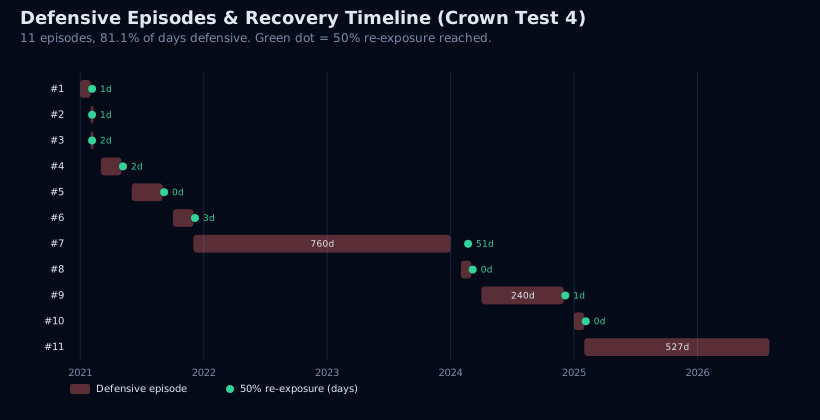
The Shield spent 1,844 of 2,275 days (81.1%) in defensive mode. Eleven distinct defensive episodes were identified:
| # | Exit date | Duration | Days to 50% | 1m | 3m | 6m | 12m | S > B&H |
|---|---|---|---|---|---|---|---|---|
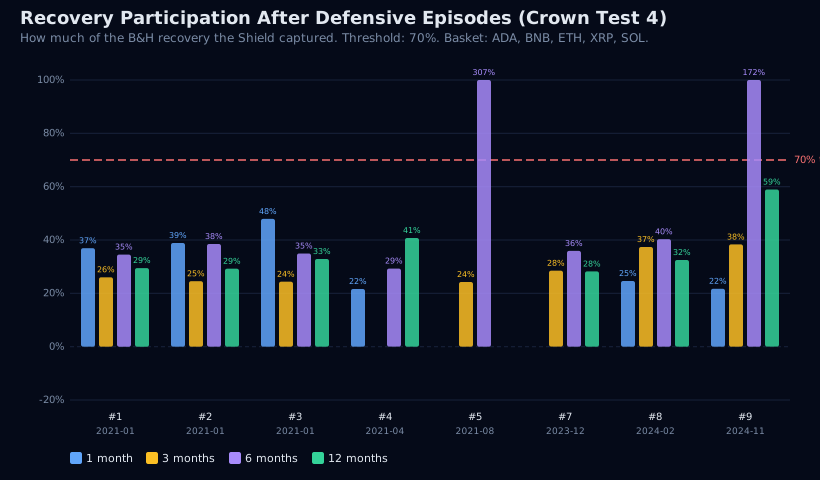
| 1 | 2021-01-06 | 34d | 1 | 37% | 26% | 35% | 29% | no |
| 2 | 2021-01-16 | 6d | 1 | 39% | 25% | 38% | 29% | no |
| 3 | 2021-01-30 | 9d | 2 | 48% | 24% | 35% | 33% | no |
| 4 | 2021-04-07 | 45d | 2 | 22% | — | 29% | 41% | no |
| 5 | 2021-08-22 | 95d | 0 | — | 24% | 307% | — | no |
| 6 | 2021-11-02 | 50d | 3 | — | — | — | — | no |
| 7 | 2023-12-24 | 760d | 51 | — | 28% | 36% | 28% | no |
| 8 | 2024-02-13 | 41d | 0 | 25% | 37% | 40% | 32% | no |
| 9 | 2024-11-14 | 240d | 1 | 22% | 38% | 172% | 59% | no |
| 10 | 2025-01-16 | 37d | 0 | — | — | — | — | no |
| 11 | 2026-07-04 | 527d | — | — | — | — | — | no |
Three facts stand out:
1. Re-entry is fast. Median 1 day to reach 50% exposure, with a range of 0–51 days. The Shield does not "lock you out." It responds to improving conditions almost immediately — except for the monster 760-day episode (#7) that spans the entire LUNA/FTX/2022 bear. 2. Participation is low. Among cycles with 12-month data, the median recovery capture is 32% of B&H — far below the 70% threshold. The Shield re-enters, but at reduced exposure, and captures a fraction of the upside. 3. Shield never catches up. Zero of seven cycles with 12m data end with Shield equity above B&H equity at 12 months. The protection gap from the defensive period is never fully closed.
4. The gate scorecard
The pass criteria from the original test plan, verbatim:
| Gate | Requirement | Result | Verdict |
|---|---|---|---|
| Median 12m participation | >= 70% of B&H | 32% | ❌ FAIL |
| Median days to 50% exposure | < 60 days | 1 | ✅ PASS |
| Worst single recovery | >= 40% of B&H | 28% | ❌ FAIL |
| Shield > B&H after 12m | >= 1 cycle | 0 | ❌ FAIL |
1 of 4. The only passing gate is the speed of re-entry — and that passes by a wide margin (1 vs 60). The participation gates fail by a wide margin too.
5. Honest reading
1. The Shield does not "lock you out" — technically. Median re-entry is 1 day. If the only question is "does the Shield get back in quickly?", the answer is yes, decisively.
2. But re-entering fast is not the same as recovering fast. The Shield comes back to 50% exposure in 1 day, but then stays at reduced exposure for months. The median 12-month participation of 32% means the Shield captures roughly one-third of what B&H earns in the recovery. The speed of re-entry is real; the recovery is not.
3. This is the same story as Crown Test 2, told from a different angle. The Shield is defensive 81% of days on the KKT portfolio. When 81% of your life is spent at reduced exposure, you are going to miss most of the upside — not because you are slow to re-enter, but because you are structurally under-invested for most of the window.
4. The protection is real; the cost is real. The Shield cut MaxDD from 81.5% to 34.2% (Test 2). That protection costs about $36k on a $30k outcome in terminal wealth, and it costs 68% of the recovery upside. Whether that trade is worth it is a personal risk-tolerance question; the data now prices it from every angle.
6. Test details
- Basket: ADA, BNB, ETH, XRP, SOL (KKT risk-parity weights)
- Weights: ERC on 180d log-return covariance, capped 40%/10% per token, 60% risky / 40% USDC structural, re-optimised every 180 days
- Window: 2020-04-10 to 2026-07-04 (2,275 days, 6.2 years)
- Start capital: $1,000 · DCA: $100 every 30 days (perfect)
- Fee: 0.1% per trade · Stablecoin yield: 0
- Shield: production
default_config, same-day execution on full portfolio equity (risky + parked USDC) - Defensive threshold: held exposure < 40% (redeploy_thresh)
- Recovery horizons: 30 / 91 / 182 / 365 days after episode exit
- Participation: Shield equity gain / B&H equity gain over same forward window; undefined when B&H loses money
7. Reproducibility
Both instruments run on the same 6.2 years of daily closes with the unmodified production engine for the Shield leg. The portfolio is constructed with the real KKT risk-parity optimizer (ERC + KKT projection), not equal weights — this is exactly what runs on the server. Test scripts, chart generators, and raw result data live in the engine's internal research tooling.
This is the fourth of five planned crown tests for the Aegis (v14) Deleverage Shield. Test 1 (Human Factor) is published here. Test 2 (Static vs Dynamic) is published here. Verdict here: 1/4 gates — the Shield re-enters fast but captures only a fraction of the recovery. Next: Test 3, liquidity execution.