← All research|Also available in 中文
Robustness — how far can reality deviate before the Shield breaks?
Published: 2026-08-07
Simulated results — no real money. Every figure below is computed from historical price data by a backtest. No capital was invested and no orders were placed. Backtests apply a strategy to the past with full knowledge of how that period turned out, and the figures exclude slippage and liquidity effects, though a simulated 0.1% exchange fee is charged on every rebalance, DCA buy and redeployment. Simulated and past performance is not a reliable indicator of future results. AQMath is software, not investment advice.
Date: 2026-08-07
Engine: Aegis (v14) Dual-Speed E2E — identical wiring to the live paper trading service (180-day KKT risk-parity MACRO loop with the ADV-K2 liveness screen + Aegis (v14) Deleverage Shield)
Status: 📊 RESEARCH — parameter plateau + reality stress, no basket promoted
1. Objective
The Regime Autopsy showed the Shield holds inside every named crash regime. The next question a skeptic asks is different: were the parameters tuned to the history we happened to get? A system can be regime-robust and still stand on a knife-edge of tuned constants — or on an execution assumption (trade exactly at the close, pay exactly 10 bps) that reality never honours.
This study attacks both fronts with 129 full walk-forward re-runs:
1. Parameter plateau — every user-facing knob moved one at a time across a wide grid around the production value, all other knobs held at production. Does performance cliff, or plateau? 2. Reality stress — trading fees from 10 to 200 bps, and shield decisions applied 1 and 2 trading days late.
Same method as the Regime Autopsy: production macro_reoptimize() and daily_step() imported unmodified, ADV-K2 liveness screen active at every re-optimisation, three baskets (A Majors+Gold, B 2019-20 Gen, C Landmine), $1,000 start + $100/30d DCA, walk-forward, no lookahead. No knob was moved in the baseline — every baseline run in this study reproduces the published figures bit for bit (A $15,650 / B $8,555 / C $17,541).
Shield constants are shown as multiples of the production value; absolute constants are not published.
2. Parameter plateau — one knob at a time
Each point below is a complete walk-forward re-run (~6 years, 12-13 re-optimisations) with exactly one knob displaced. Amber column: the production setting.
| Knob | Grid | Calmar A | Calmar B | Calmar C | Verdict |
|---|---|---|---|---|---|
| Macro lookback | 90-240 d | 0.51-0.89 | -0.12-0.12 | 0.40-0.79 | varies, no cliff |
| Re-opt cadence | 90-240 d | 0.31-0.77 | -0.10-0.12 | 0.47-0.72 | varies, no cliff |
| Drawdown reference | 0.53×-2.67× | 0.49-0.62 | 0.08-0.17 | 0.58-0.70 | protection dial |
| Rebalance threshold | 0.38×-3.13× | 0.50-0.57 | 0.06-0.14 | 0.63-0.74 | flat |
| Downside window | 0.50×-2.00× | 0.53-0.57 | 0.10-0.12 | 0.65-0.70 | flat |
| Risk budget | 0.70-1.00 | 0.57 | 0.12 | 0.65 | no-op (verified) |
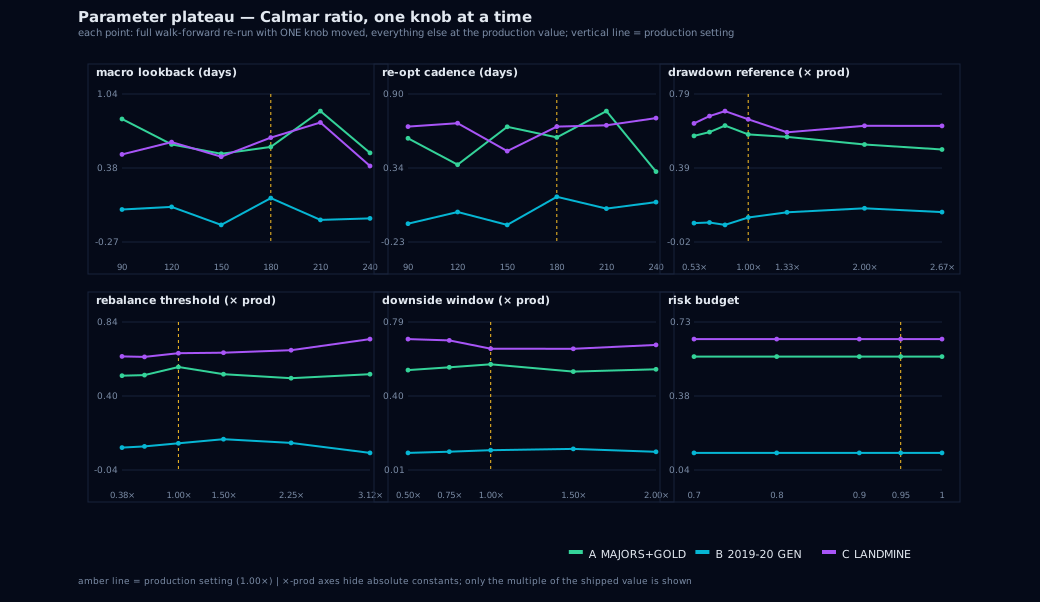
The flat knobs. The rebalance threshold and the downside-volatility window barely move anything across their entire grids — on basket A the Calmar band is 0.50-0.57 and the max-drawdown band under 2.4 pp. These are true plateaus: the system does not care where in the tested range they sit.
The dial. The shield's drawdown reference behaves exactly like a protection dial, not like a fragile constant. Tightening it trades participation for protection monotonically — on basket A the full-window max drawdown moves from 25.1% at 2.67× to 14.6% at 0.53× of production — while the Calmar stays inside a 0.49-0.62 band at every point. No grid point breaks the mechanism; the knob chooses how much protection, not whether it works.
The macro knobs. Lookback and re-optimisation cadence produce the widest spread (on A, final equity ranges $14.5k-$23.3k with lookback alone). This is honesty, not robustness theatre: the covariance window genuinely changes which weights get frozen. What matters for this study is the shape — every grid point on baskets A and C keeps a positive Calmar and stays inside a narrow max-drawdown band (16.9-18.9% on A). No cliff anywhere in the grid. Basket B remains the weak basket at every setting, consistent with the Regime Autopsy: its full-window case never rested on tuning.
The no-op. The risk-budget knob scales the reported risky exposure but is not applied to returns in the Aegis (v14) accounting — the grid confirms this is exact, not approximate: five settings, identical equity to the cent. We publish this because a knob that looks protective but is cosmetic should be known, not assumed.
3. Reality stress — fees
Every trade in the system (shield rebalances, DCA buys, tranche redeployment) pays a simulated fee. The grid stresses it from the production 10 bps to 20× that level.
| Fee | A final | A Calmar | B final | B Calmar | C final | C Calmar |
|---|---|---|---|---|---|---|
| 10 bps | $15,650 | 0.57 | $8,555 | 0.12 | $17,541 | 0.65 |
| 25 bps | $15,382 | 0.55 | $8,442 | 0.10 | $17,260 | 0.63 |
| 50 bps | $14,948 | 0.51 | $8,257 | 0.08 | $16,803 | 0.60 |
| 100 bps | $14,123 | 0.43 | $7,902 | 0.04 | $15,929 | 0.54 |
| 200 bps | $12,630 | 0.31 | $7,249 | -0.04 | $14,334 | 0.42 |
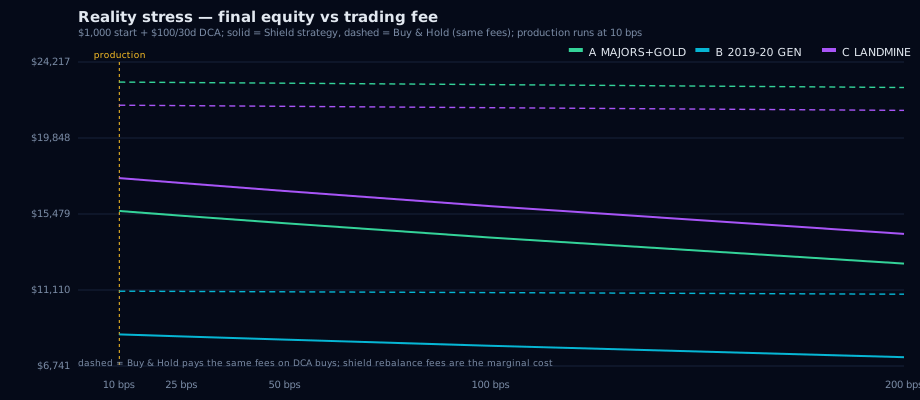
The degradation is graceful and roughly linear. At 100 bps — an order of magnitude above production and above realistic retail taker fees — baskets A and C still carry their strongest risk-adjusted numbers from most published studies. Basket B, already marginal, crosses below zero only at 200 bps. Buy & Hold pays the same fee on its DCA buys, so the Shield's marginal cost is only the rebalance turnover — and threshold rebalancing was designed precisely to keep that turnover down (the grid's fee totals confirm it).
4. Reality stress — late execution
The daily loop trades on the close after evaluating the shield on that same close. What if the order lands a day or two late? The shield's exposure decisions were delayed by 1 and 2 trading days, with everything else — accounting, fees, DCA, redeployment — left on the production code path.
| Lag | A MDD | B MDD | C MDD | Buy & Hold (A/B/C) |
|---|---|---|---|---|
| 0 d (production) | 16.9% | 18.9% | 17.8% | 43.2% / 37.5% / 31.2% |
| 1 day late | 19.3% | 22.0% | 17.6% | unchanged |
| 2 days late | 19.5% | 21.6% | 17.8% | unchanged |
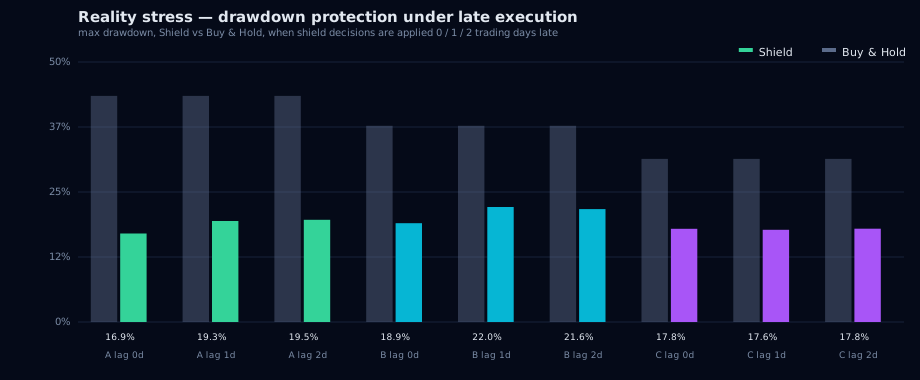
Late execution costs roughly 2.4-3.1 pp of drawdown protection on baskets A and B and essentially nothing on C — and the protection stays large: even two days late, the Shield's max drawdown on basket A is 19.5% against Buy & Hold's 43.2%, a cut of ~24 pp. Final equity is almost unaffected (it even moves slightly up in two of six cells — the shield is not a timing system, so late is not systematically worse, just slightly blunter). A daily-close system that cannot trade instantly still does its job.
5. Caveats
- One-at-a-time design. Every point moves exactly one knob. The grid proves there is no single-knob cliff, but it does not explore knob interactions; a hostile corner of the joint space is not ruled out.
- Fees on weight rotation. As in every earlier study, the weight change at a macro re-optimisation is not charged. Faster cadences therefore look slightly cheaper than they would live; the fee-stress results are the conservative complement of that assumption.
- The lag model delays the shield's decisions as a block, including its internal ramp feedback. It is an upper bound on sloppiness, not an order book model.
- Basket B stays the honest exception across the whole study: weak full-window numbers at every setting. It is kept because a robustness claim that hides its worst basket is not a robustness claim.
6. Verdict
No cliff found anywhere in the tested space. Two knobs are true plateaus, one behaves as a clean protection dial, the macro knobs vary the level but never break the mechanism, fees degrade the system gracefully far beyond realistic levels, and execution two days late keeps almost the entire drawdown cut. The Shield's published results do not stand on a knife-edge of tuned constants or on perfect execution.
Simulated on historical daily closes with fees; nothing here is financial advice.